
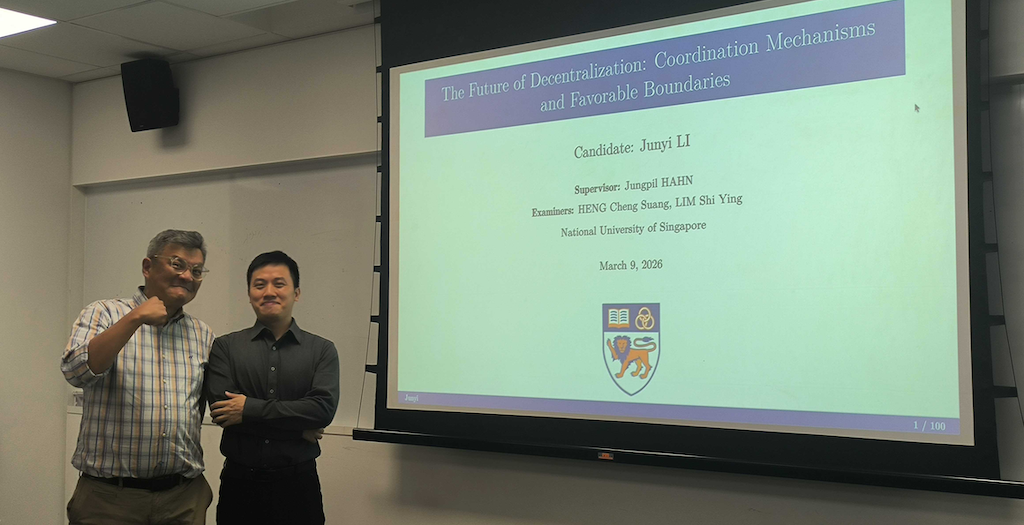
PhD Defense – Li Junyi
Date/Time/Venue: 9 March 2026 @ 2:00PM @ COM3-MR20
Dissertation Title: The Future of Decentralization: Coordination Mechanisms and Favorable Boundaries
Examiners: A/P Heng Cheng Suang, Dr. Lim Shi Ying
Abstract:
This thesis examines two foundational aspects of decentralization in IT-enabled organizing: decentralized decision rights and distributed expertise.
The first essay concerns decentralized decision rights. The rise of DAO-like structures departs from the classic trade-off between decentralization and centralization, embracing full decentralization rather than striking a balance between the two. Is a fully decentralized structure merely fraught with weaknesses, or does it also yield distinct strengths? Drawing on the organization design literature, I formalize a computational model that scaffolds the concept of DAO-like structure. Computationally intensive analysis characterizes DAO-like structures as an alternation between belief disparity and alignment. This reframes the classic structural trade-off as a tension in knowledge aggregation. This tension stems from the inherent difficulty of elevating local beliefs into global consensus in DAO-like structures, which in turn mitigates mismatches between token distribution and idea quality. I conduct a systematic exploration of the vulnerabilities and favorable conditions of DAO-like structures across variations in voting thresholds, token asymmetry, participation rates, and incentive designs. This essay advances a knowledge-aggregation perspective to explain how collective intelligence can emerge from autonomous individuals asserting their own knowledge through token-weighted voting.
The second essay concerns distributed expertise. Crowdsourcing systems have largely drawn on the theory of parallel search to justify scaling participation. In this view, crowdsourcing is conceptualized as a sampling process composed of multiple independent trials that “hack” the problem landscape in pursuit of breakthroughs. Each solver is treated as a random draw from the distribution of possible solutions. I argue that heterogeneity in where solvers possess knowledge does more than determine where search begins; it also shapes how search unfolds along solvers’ underlying knowledge structures. Searches that unfold along structured dimensions of knowledge breadth and depth are not interchangeable forms of sampling. I formalize the canonical notion of parallel search into a computational model and refine the random-sampling assumption into knowledge-structured search. This parsimonious extension yields new implications for when and how crowdsourcing systems can structure scaling and sharing strategies, moving beyond uniform scaling and undifferentiated sharing. I synthesize these implications as novel design levers centered on managing the interpretive tension between joint confirmation and mutual deviation. This essay advances an interpretive–evolutionary account of crowdsourcing and extends parallel search theory by linking macro-level idea development to micro-level heterogeneity in knowledge structures and interpretive dynamics.
Both essays offer replicable and extensible computational models that allow scholars to move beyond the deliberate parsimony of these models. This thesis advances theoretical insights into how collective intelligence emerges from autonomous, decentralized, and imperfectly knowledgeable crowds. It distills design levers to enhance collective intelligence in DAO-like structures and crowdsourcing systems.